

Happy Weekend.
It's the short week that always bookends Summer — the one that quietly starts it and, come September, quietly finishes it.
And Charleston made sure we knew which end we were on. Full Summer mode: thick humidity, the kind that greets you at the door. As many of our leaders made their way here for strategic planning, they got to experience the beginning of summer with us. There's something fitting about gathering to plan the future in a place that forces you to slow down the moment you step outside.
Speaking of getting practical: this week's How I AI session got into MCPs — and how connecting one to your firm's data changes the way you actually work, report, and scale. Less "AI is coming for wealth management," more "here's the plumbing that makes your stack talk to itself." If you missed it, it's worth the watch.
Which, oddly enough, is where this week's article lands too. I caught a conversation between David Senra and Rick Rubin that got me thinking about how much we add to the things we build — and how often the adding is what gets in the way.
More on that below.
Reduced By
Podcast: How Modern RIAs Can Scale Fast 🎧
Webinar Replay: What the Heck is an MCP?
Milemarker On the Road ✈️
Reduced By
During some down moments this week, I caught a conversation between David Senra and Rick Rubin. Two guys are sitting outside, sipping on iced tea, talking. Rubin is perched cross-legged, fielding a series of really well-researched questions while they talk.
Senra started in on the 18-year-old version of Rubin. A Manhattan-based student who fell deeply into the music scene shortly after he launched Def Jam Records from his college dorm room.
Early on, Rubin talks about how he viewed his role when he first started making records. He was very focused on hip hop music, which was widely misunderstood at the time. In Rubin’s opinion, recordings made at the time lacked soul. He thought the recordings lacked the energy the musicians had when they performed live.
As Rubin started helping make records, he opted not to call himself a producer. On that first record, the credit read "reduced by Rick Rubin."
Forty years later, Rubin has shaped some of modern music's greatest works. All of it starting from that same place: reduction.
He explained the trap. When you record a guitar part, the best practice is to layer additional takes of the same part on top of one another, creating a fuller, more complete sound.
When stacking those layers, you can lose the purity of the actual recording. You lose the original take. How the instrument was actually played. The style of the player. The very thing that made it worth recording.
The thing that separates Angus Young from a random studio musician who has played this same track a hundred times before.
For Rubin, the test for a song is brutal and simple: strip it down to one acoustic guitar. If it's great there, you can build a hundred versions, and it'll still be great. If it isn't, no amount of production will save it.
Somehow, in all those overdubs, I could not help but see the unintentional and often intentional complexity that comes with the way the wealth management industry serves the people who count on us.
We've never had more ways to reach a client. Portals. Apps. Dashboards. Compliant text messaging with brilliant tools like Current Client (shoutout Dustin). Quarterly reports thick enough to prop a door open. Automated birthday texts. AI-written market commentary. A drip campaign for every life event.
More touchpoints than ever. Less actual touch.
We layer and layer until the client can't find the one thing they came for, their relationship with an advisor or team who actually knows and cares about them.
Your read on their life.
The sense that someone is actually holding the thing they're most afraid of. The annual review becomes forty slides of performance charts. The client nods, says thank you, and walks out carrying the exact question they walked in with: am I going to be okay?
That question never needed a dashboard. It needed you, in the room, answering it.
Strip away the portals, and the reports, and the automation, and what's left is trust, presence, and judgment. That's the take worth recording. Everything else is overdub.
Last month, the Foo Fighters did the same thing Rubin describes. A band that sells out Wembley for multiple nights played a couple of secret club shows in New York and New Jersey. Thirty bucks, sold in person at the door, a thousand people close enough to count faces. They stripped away the arena: the giant stage, the rushed festival set, the distance. What was left was the band and the song, six feet away. Everyone who got in knew it was the best night.
It's a show they'll remember for a long time — versus a seat 100 yards back, watching the Jumbotron.
Our clients are no different. They won't remember the dashboard. They'll remember the call you made on the worst day of their year. They'll remember being seen.
So here's the question I'm sitting with this week. Not what else can I add — another report, another touchpoint, another automated kindness — but what could I strip away to get closer? What's standing between the person actually in front of me and me?
The most valuable thing you offer can't be layered on. It can only be uncovered.
Connect first. Everything else is overdub.
On the Pod: How Modern RIAs Can Scale Fast
Episode 146: On this week’s episode, Kyle Van Pelt talks with Vib Arya and Sean Meighan of Envestnet. As Head of Strategic Relationship Management, Vib is a seasoned wealth and investment management leader with more than 25 years of experience driving innovation and efficiency across RIA, institutional, wirehouse, and fintech channels. As Head of RIA Distribution, Sean has spent his career helping advisory firms navigate growth, technology adoption, and operational strategy within the evolving RIA landscape.
Vib and Sean talk with Kyle about how modern RIAs can scale fast. They explore how technology has evolved from a support function into a true growth multiplier, powering efficiency, enabling personalization at scale, and helping firms navigate complexity. They also discuss the ongoing battle against tech sprawl and how Unified Managed Accounts (UMAs) act less like a product and more like an automated trading chassis capable of handling everything from high-net-worth personalization to account efficiency.
In this episode:
(00:00) - Intro
(01:11) - How technology fits into the RIA growth equation
(02:34) - Designing the ideal advisor workflow
(04:00) - What shaped Sean’s and Vib’s technology philosophy
(08:49) - Diagnosing tech stacks and aligning them with firm strategy
(13:00) - The hidden cost of tech sprawl
(18:01) - How UMAs are evolving for modern RIAs
(24:29) - Separating AI hype from practical application in wealth management
(31:49) - Vib’s and Sean's Milemarker Minute
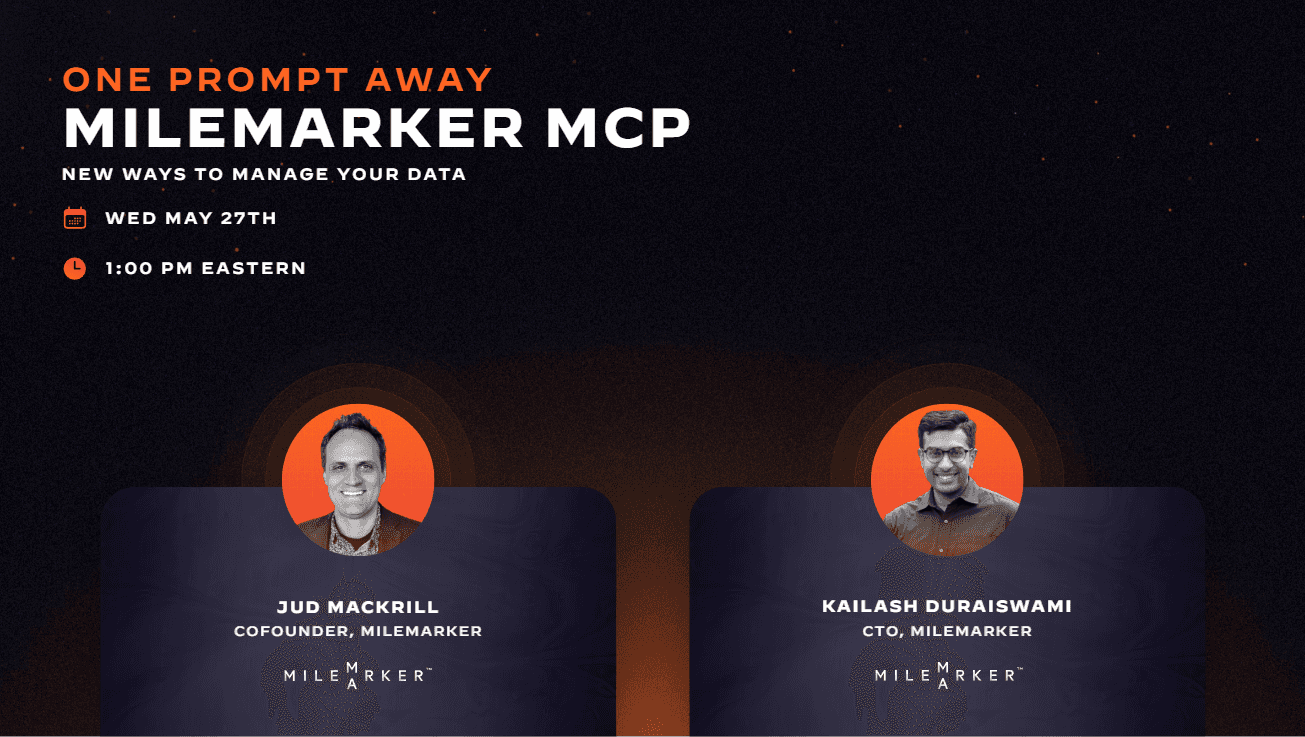
Webinar Replay: What the Heck is an MCP?
Thank you to my colleague Kailash Duraiswami for joining me to discuss how firms are using AI and MCP to simplify operations and unlock more value from their technology.
If you missed the live session, you can watch the full replay here:
Milemarker on the Road
Catch my team on the road at the following events or cities:
Boise, ID — June 2-4
Denver, CO — June 1-4
Boca Raton, FL — June 9-11
London — June 10-14
New York — June 17-18
Omaha, NE — June 21-24
Madison, WI — June 27-28
If you would like to arrange a meeting time, please reply to this email, and we’ll schedule something on the calendar.
Jud Mackrill