

I’m wheels up from Denver, headed back to the South Carolina Lowcountry.
My Spotify is playing The Bronx (III) while I get caught up on emails and troubleshoot lousy airplane Wi-Fi.
This week was a blast.

Great time with our team in Denver
I just wrapped up our Engineering summit in the Denver Tech Center, where we gathered our engineering leaders across the country to plan out the next stage of solutions for the industry.
Prior to that, I spent time with partners, clients, and industry friends at Pershing INSITE. It was a really well-done event, and we will be glad to return in future years. Thanks again to the team at BNY for hosting us.
My article this week is a reflection on a bit of how I grew up and some unique perspective that I believe is relevant today — all centered around Sweet Clover.
Tenants, Not Landlords
Podcast: The Hidden Economics Behind High-Growth Advisory Firms 🎧
Wealthies Nominations: CTO of the Year and Data Engine
Milemarker On the Road ✈️
Tenants, Not Landlords
I hope you're having a great weekend.
I spent most of this week in Denver. Walked every morning before the meetings started and got to enjoy where the Great Plains run into the Rockies.
Most people call it flyover country. The part of the map you sleep through.
But, I think they're wrong.
The plains are one of the most diverse ecosystems on earth. Grasses, thistles, legumes. This is the land that once held millions of bison.
I grew up on it.
While walking among the grasses this week, one plant caught my eye and stopped me in my tracks. Sweet clover.
Growing up, my family kept bees. Six thousand hives that followed the bloom from the Dakotas to Texas to California. The secret to the finest honey in the world isn't a secret; it’s what they pollinate. You put bees on clover and alfalfa? That's it.
No two operations make the same honey. Ours tasted like our land, because it came from our land, and nobody could replicate it exactly.
So I wasn't just looking at a plant. I was looking at the thing that built my family.
Here's what most people forget about that land.
Decades ago, the government rolled out the Conservation Reserve Program (CRP). The pitch was almost heretical to a farmer: stop farming some of this.
The suggestion wasn’t made because the land was worthless. It was because it had been worked until it couldn't give anything back.
So they let it go back to grass.
And the land didn't just recover. It exploded. Ducks, pheasants, waterfowl in numbers nobody expected. Some of the best hunting in the world grew out of one decision.
Stop ruthless extraction. Start restoring.
Yesterday I listened to Susie Cranston, the CEO of Cresset, talk about the future of her firm. She named two things.
Build a place that attracts talent and lets it thrive.
And own her data.
She was describing the CRP without knowing it.
Most firms haven't farmed their data to death. They've done something more understandable.
They kept adding.
Another vendor. Another point solution. Another system bolted on to patch the last one. Every purchase solved a real problem the day it was made. Stack ten years of them together and you get what most firms have now. A stack nobody fully controls, on ground nobody owns.
I sat with a firm last month that wanted one number. Total revenue by advisor, blended across two custodians. Simple question. It took three people, two logins, and most of a week to answer. Not because they're bad at their jobs. Because the answer lived in someone else's system, in someone else's format, on land they didn't own.
Here's what almost nobody says out loud. While the mess can look overwhelming, much more of this is in your control than you think, but only if you own your data.
Own it, and the vendors become tenants, not landlords. You decide what stays, what goes, what comes back. You stop renting access to your own business.
Sweet clover reminded me of something this week.
The clover doesn't just keep the soil in place. It feeds the bees that make honey. The land, the clover, and the bees are all necessary to make the one that only our land could make.
Restoration doesn't just bring back what you lost.
It produces something only you can make.
The firms that win the next decade won't be the ones who planted the most.
They'll be the ones who restored the land.
And tasted what came back.
Episode 147: On this week’s episode, Kyle Van Pelt talks with Patrick Kelly, Co-Founder and CEO of Signal Advisors. Patrick started his career as a financial advisor at Northwestern Mutual before becoming an independent advisor. Before Signal, Patrick founded RepPro, the first electronic application platform for fixed and fixed index annuities in the IMO business.
Patrick talks with Kyle about the hidden economics behind high-growth advisory firms. He discusses why some of the fastest-growing advisors integrate insurance, annuities, and investment management into a cohesive strategy, and how pairing this with recurring revenue can unlock both growth and enterprise value. Patrick also explores how technology simplifies operations, improves visibility into marketing performance, and ultimately helps advisors make better business decisions and enhance client experiences.
In this episode:
(00:00) - Intro
(02:02) - Patrick's money moment
(05:06) - Where Signal Advisors fits in the modern advisor ecosystem
(07:11) - Why insurance technology still lags behind wealthtech
(10:52) - The hidden limitations of basic data feeds
(15:12) - Rethinking the commission vs. fee-based debate
(17:10) - The evolution of fee-based annuities and advisor adoption
(19:47) - The real engine behind advisor growth and enterprise value
(21:07) - How Signal Advisors survived its early cash flow challenges
(28:25) - Building a tech stack around advisor economics and visibility
(34:01) - Why advisors work with so many carriers
(36:14) - Patrick’s vision for the future of Signal Advisors
(40:35) - Why AI should improve experience before efficiency
(43:37) - Patrick's Milemarker Minute
Milemarker Nominated for Two Wealthies
A quick note: Milemarker was nominated for two WealthManagement.com Industry Awards this year — the Wealthies. Kailash Duriaswami, our CTO, is nominated for Chief Technology Officer of the Year. And Data Engine is nominated for Data Lakes/Warehouses.
We share this because it reflects something worth naming: the industry is beginning to recognize that infrastructure is the right category for wealth management technology. Structured, normalized data at scale is not a feature — it is a foundation.
Thank you to every firm that has trusted Milemarker to be that foundation.
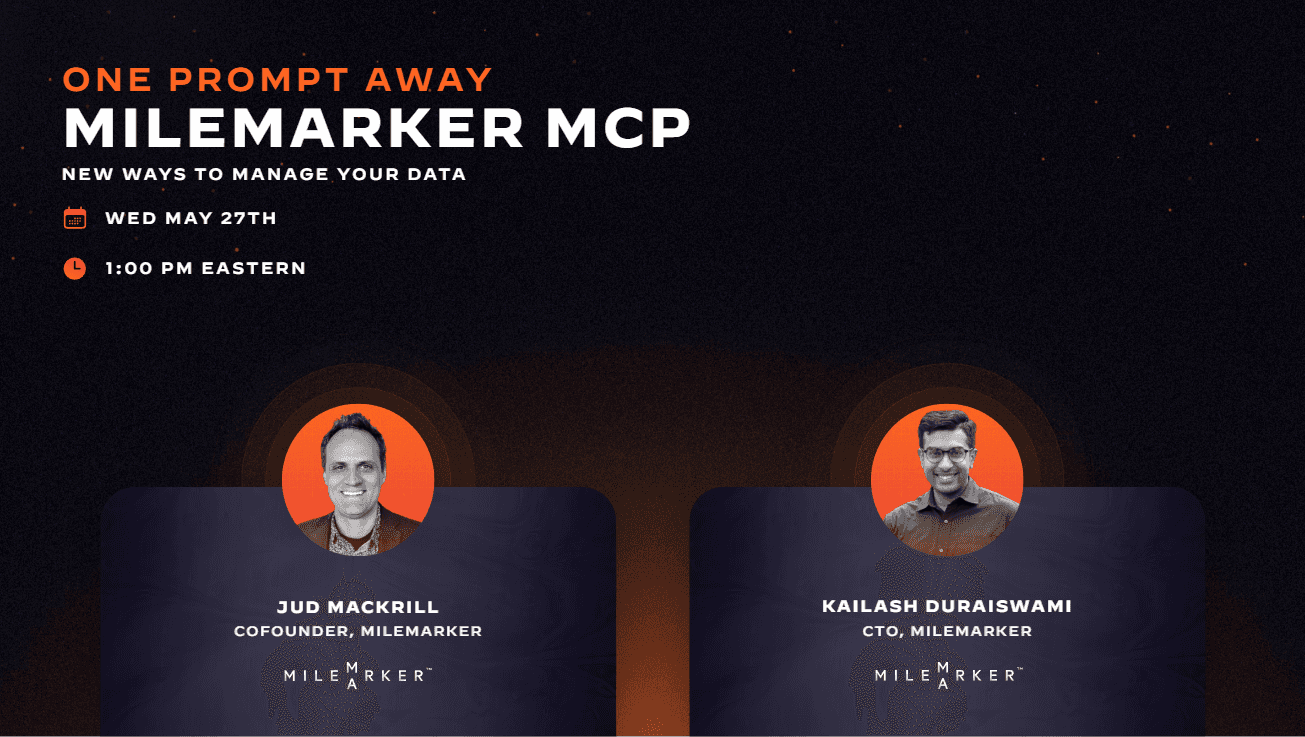
Webinar Replay: What the Heck is an MCP?
Thank you to my colleague Kailash Duraiswami for joining me to discuss how firms are using AI and MCP to simplify operations and unlock more value from their technology.
If you missed the live session, you can watch the full replay here:
Milemarker on the Road
Catch my team on the road at the following events or cities:
Boca Raton, FL — June 9-11
London — June 10-14
New York — June 17-18
Omaha, NE — June 21-24
Kansas City - June 24
Madison, WI — June 27-28
If you would like to arrange a meeting time, please reply to this email, and we’ll schedule something on the calendar.
Jud Mackrill